

Why Is My AC Blowing Warm Air? 7 Causes Houston Homeowners Should Check
AC blowing warm air? Our guide helps Houston homeowners diagnose 7 common causes, from simple thermostat fixes to knowing when to call for service.
Hage Energy
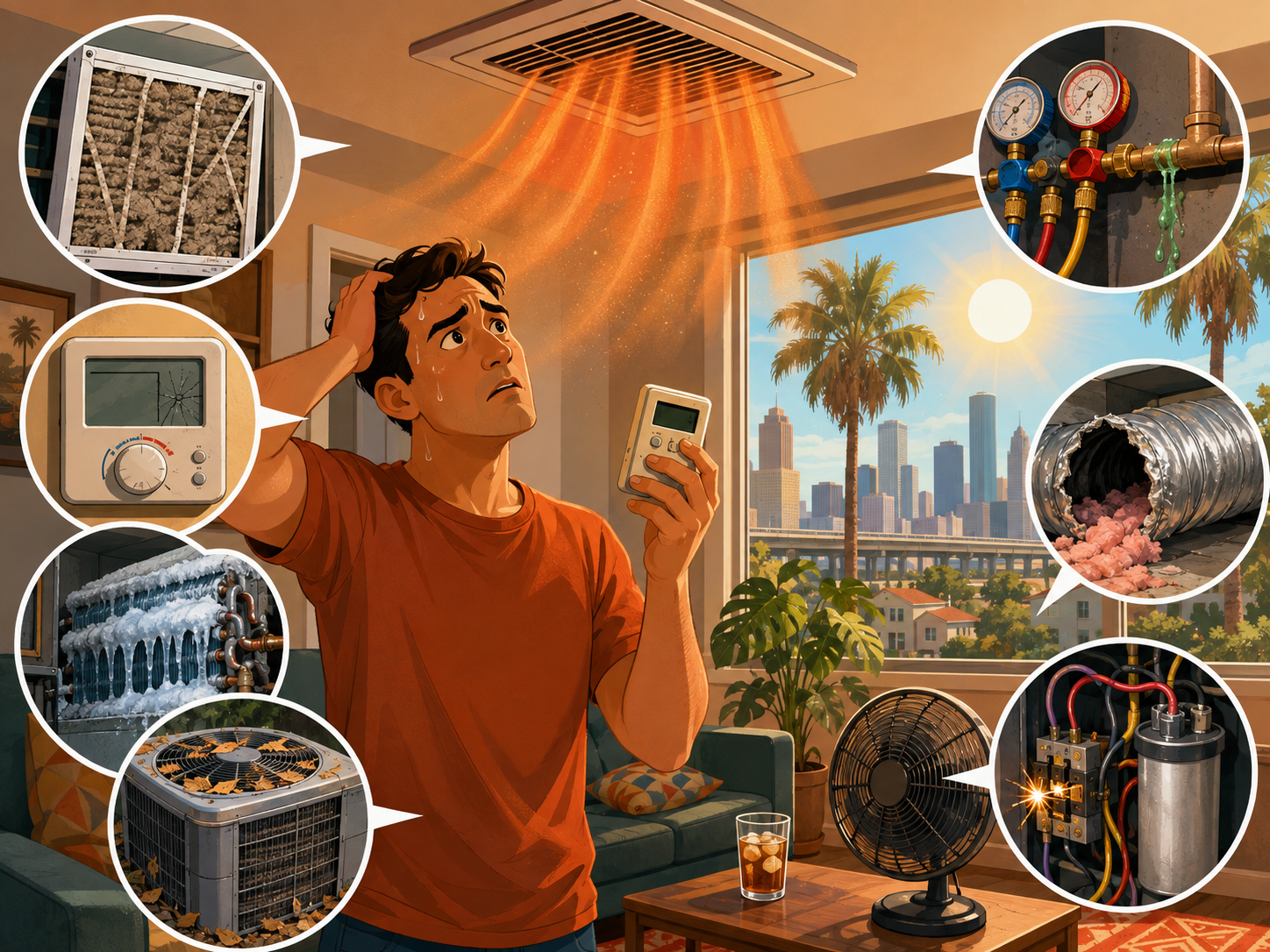
If your AC is running but warm or room-temperature air is coming from the vents, start with three things: check the thermostat, inspect the air filter, and see whether the outdoor AC unit is operating.
Warm air usually means the indoor blower is moving air through your home while something is preventing the system from removing heat properly. The cause may be as simple as a thermostat setting or tripped breaker, but it can also involve a frozen coil, refrigerant leak, dirty condenser, electrical failure, or compressor problem.
Houston's summer heat can make an air conditioner run for long periods. It should not, however, make a properly operating cooling system continuously blow warm air.
First: Is the Air Actually Warm or Just Not as Cold as You Expected?
This distinction can provide a useful troubleshooting clue.
If the air coming from your vents feels close to the same temperature as the room, the blower may simply be circulating unconditioned indoor air. That can happen when the thermostat fan is set to On, the outdoor unit has lost power, or the cooling cycle has failed to start.
If the air feels noticeably hot rather than simply room-temperature, check the thermostat immediately to make sure the system is not in Heat mode. For homes with heat pumps, a control or reversing-valve problem can also prevent the system from switching correctly into cooling mode.
A brief period of warmer air as equipment starts or between cooling cycles does not necessarily indicate a failure. Persistent warm air while the thermostat is calling for cooling does.
Before You Troubleshoot: Know When to Turn the AC Off
Stop the cooling system and request professional service if you notice:
- Smoke, sparks, or a burning or melting-plastic smell
- A breaker that trips repeatedly
- Significant ice on refrigerant piping or the indoor coil
- Water around electrical equipment
- Severe buzzing, grinding, or metal-on-metal noise
- An outdoor unit that hums but its fan does not operate
- Any condition that appears electrically unsafe
Do not open electrical panels, test or replace capacitors, bypass safety controls, add refrigerant, or attempt to manually start an outdoor fan.
For everything else, work through these seven causes in order.
1. The Thermostat Is Set Incorrectly
Start here because the thermostat can create warm-air symptoms even when nothing has failed mechanically.
Confirm that it is:
- Set to Cool
- Set below the current indoor temperature
- Not set to Heat
- Using the intended schedule
- Showing a normal display
- Set with the fan on Auto rather than continuously On
The fan setting is particularly important.
When the thermostat fan is set to On, the indoor blower can continue moving air after the compressor has stopped cooling. The air coming from the vents then gradually feels warmer because the system is circulating room-temperature air.
Setting the fan to Auto normally allows the blower to operate with the cooling cycle instead.
If your thermostat uses replaceable batteries and its display is weak, blank, or behaving abnormally, replace the batteries with the correct type.
If the thermostat appears to be calling for cooling but the equipment does not respond correctly, the problem may involve the thermostat itself, low-voltage wiring, a control board, or another system control.
2. The Outdoor AC Unit Has Lost Power
Central air-conditioning systems have indoor and outdoor components. The indoor blower can sometimes continue operating even when the outdoor condenser has stopped.
That creates a classic warm-air symptom: you hear the system and feel air at the vents, but the refrigeration cycle is not actually cooling it.
While the thermostat is calling for cooling, look at the outdoor unit from a safe distance.
If it is completely silent and the fan is not operating, check your home's electrical panel for a clearly tripped AC or condenser breaker.
If a breaker has tripped and there are no signs of burning, water, or electrical damage, it can be reset once. If it trips again, leave it off and schedule service. A repeatedly tripping breaker indicates an underlying problem that should be diagnosed rather than repeatedly reset.
Do not open the outdoor disconnect or equipment cabinet to troubleshoot wiring yourself.
If the breaker is on but the outdoor unit remains off, a control, contactor, capacitor, motor, wiring, or compressor problem may be preventing it from starting.
If the outdoor system is not operating normally, Hage Energy provides air conditioning repair and service in Houston.
3. A Dirty Filter Is Restricting Airflow
A badly clogged air filter can reduce airflow through the HVAC system.
That matters because your evaporator coil needs a steady flow of indoor air moving across it. When airflow becomes restricted, cooling performance can fall and the coil may eventually become cold enough to freeze.
Check the filter and replace a visibly dirty disposable filter with the correct size and type for the system.
Also make sure:
- Return-air grilles are not blocked by furniture or other objects
- Supply registers are open
- Rugs, curtains, or furniture are not covering vents
- You have not closed a large number of supply registers in an attempt to redirect cooling
A dirty filter is more likely when warm-air symptoms occur along with weak airflow.
If airflow remains weak after installing a clean filter, the problem may involve the blower, evaporator coil, return-air system, or ductwork rather than the filter itself.
Regular AC maintenance and HVAC tune-ups can also help identify airflow, coil, electrical, and operating issues before they turn into a no-cooling call.
4. The Evaporator Coil Is Frozen
A frozen air conditioner can eventually blow little or no cold air even though the system continues to run.
The evaporator coil is the indoor component that absorbs heat from your home's air. When its operating conditions are incorrect, ice can form on the coil and restrict airflow even further.
Signs of a frozen coil can include:
- Weak airflow from the vents
- Ice on visible refrigerant piping
- Ice around the indoor equipment
- Cooling performance that gets progressively worse
- Water around the indoor unit after the ice begins melting
Restricted airflow is one possible cause. Refrigerant problems, dirty coils, blower problems, and other system conditions can also contribute.
If you see significant ice, turn the cooling off. Do not scrape, chip, or break the ice away.
Allowing the ice to melt addresses the immediate frozen condition, but it does not identify why the coil froze. If icing returns or the AC still blows warm air after thawing, the underlying problem needs professional diagnosis.
If you see ice on the equipment or refrigerant lines, read Hage Energy's guide on what a frozen AC can mean and what to do next.
5. The Outdoor Condenser Cannot Release Heat Properly
An air conditioner does not simply “make cold air.” It removes heat from inside your home and releases that heat outdoors.
The outdoor condenser needs adequate airflow to do that job.
Grass clippings, leaves, vegetation, dirt, or other debris around the outdoor equipment can interfere with airflow and reduce heat transfer. A severely dirty condenser coil can reduce cooling performance even while the equipment appears to be running.
From outside the cabinet, check whether:
- Leaves or debris are packed around the equipment
- Vegetation is growing against the unit
- Stored objects are blocking airflow
- The coil surface appears heavily contaminated
- The outdoor fan appears to be operating normally
You can remove loose yard debris from around the equipment without opening the cabinet.
Do not remove panels, reach through the fan guard, bend coil fins, or use aggressive pressure washing on the condenser. Coil cleaning that requires access to the equipment should be handled as part of professional service.
If the outdoor unit is operating but the vent air remains warm, the problem may extend beyond simple airflow around the condenser.
6. The System Is Low on Refrigerant
Refrigerant allows the air-conditioning system to absorb heat indoors and release it outside.
If the refrigerant charge is too low, the air conditioner may lose cooling capacity, run for long periods, and eventually send air from the vents that no longer feels cold. Low refrigerant can also contribute to evaporator-coil icing.
A properly operating air-conditioning system does not consume refrigerant like a vehicle consumes fuel. If a correctly charged system becomes low, a refrigerant leak is a likely concern.
Possible signs include:
- Reduced cooling capacity
- Long cooling cycles
- Ice on the evaporator coil or refrigerant line
- A system that gradually performs worse
- Warm or only slightly cool supply air
These symptoms do not prove that refrigerant is the problem. Airflow and mechanical failures can produce similar symptoms.
Refrigerant should therefore be tested rather than guessed at.
Adding refrigerant without determining why the charge is incorrect can leave the actual problem unresolved. Refrigerant-system diagnosis and repair require appropriate tools, training, and handling procedures and should be performed by a qualified HVAC technician.
Hage Energy's guide to why an AC may need more refrigerant explains why repeatedly topping off a leaking system is not a long-term solution.
7. An Electrical, Mechanical, or Heat-Pump Component Has Failed
If the thermostat is correct, airflow looks normal, the filter is clean, and the AC is still blowing warm air, a component may not be operating correctly.
Possible problems include:
- Failed capacitor
- Failed contactor
- Condenser fan motor problem
- Compressor problem
- Damaged wiring or electrical connection
- Control-board failure
- Thermostat or low-voltage control problem
A system can sometimes look partially operational even when one of these components has failed. For example, the indoor blower may run while the compressor never starts.
What If You Have a Heat Pump?
A heat pump uses the same equipment to provide both heating and cooling by changing the direction of refrigerant flow.
A component called the reversing valve allows it to switch between those modes.
If a heat pump is set to Cool but produces air that feels genuinely heated rather than simply room-temperature, a thermostat, control, or reversing-valve problem may be involved.
A reversing valve is not a homeowner repair. Diagnosing it can involve electrical testing and refrigerant-system measurements.
What Your AC's Symptoms Can Tell You
| What You Notice | Problems Worth Investigating |
|---|---|
| Indoor fan runs but outdoor unit is completely off | Power, breaker, thermostat signal, contactor, capacitor, controls, motor, or compressor |
| Warm air and noticeably weak airflow | Dirty filter, frozen coil, blower problem, dirty indoor coil, or airflow restriction |
| Warm air plus visible ice | Frozen evaporator coil, airflow problem, refrigerant problem, or blower issue |
| Outdoor equipment runs but the vent air stays warm | Dirty condenser, refrigerant problem, compressor issue, control problem, or other loss of cooling capacity |
| Air feels warm between cooling cycles with fan set to On | Thermostat fan setting may be circulating room-temperature air |
| Heat pump produces clearly heated air while set to Cool | Thermostat setting, controls, or reversing-valve problem |
| Breaker trips again after being reset | Electrical, motor, compressor, wiring, or component problem |
These clues can help point the diagnostic process in the right direction, but they cannot confirm which part has failed.
Can Houston's Extreme Heat Make an AC Blow Warm Air?
Houston heat can make an air conditioner run longer, especially during peak afternoon conditions. Longer runtime by itself does not mean the system is broken.
Warm air from the vents is different.
When the thermostat is calling for cooling and the system is operating correctly, the equipment should still be removing heat from the air. If the supply air remains warm or room-temperature, do not assume the outdoor temperature is the entire explanation.
High outdoor temperatures can expose a system that already has reduced capacity because of dirty coils, weak components, refrigerant problems, or airflow restrictions. That is one reason a problem may become much more noticeable during a Houston afternoon than it was earlier in the day.
If your AC is cooling but simply cannot keep the entire house comfortable, see Hage Energy's broader AC not cooling in Houston guide. It covers issues such as duct leakage, uneven temperatures, humidity, system runtime, and whole-home cooling performance.
What Should You Check Yourself Before Calling Hage Energy?
For a warm-air complaint, a homeowner can safely complete this short sequence:
- Confirm the thermostat is set to Cool.
- Set the thermostat fan to Auto.
- Make sure the cooling setpoint is below the indoor temperature.
- Inspect the air filter.
- Make sure supply and return vents are unobstructed.
- Look at the outdoor unit without opening it.
- Check the electrical panel for a tripped AC breaker.
- Look for visible ice, water, burning smells, or abnormal noises.
If one of those simple checks solves the problem, continue monitoring the system.
If the AC still blows warm air, the next step should be diagnosis rather than replacing parts based on symptoms.
When Does Warm Air Require Professional AC Repair?
Schedule professional AC repair when:
- The outdoor unit will not start
- A breaker trips again
- The AC continues blowing warm air with correct thermostat settings
- Ice forms on the system
- Airflow remains weak with a clean filter
- The condenser runs but cooling does not return
- You suspect a refrigerant problem
- The equipment buzzes, hums, or makes abnormal mechanical noises
- A heat pump appears stuck in heating mode
- The same warm-air problem keeps returning
A professional diagnostic may include evaluating thermostat operation, airflow, temperature performance, electrical components, capacitors and contactors, condenser-fan operation, compressor performance, coil condition, refrigerant performance, and system controls.
The purpose is to identify the failed condition before recommending a repair.
AC Blowing Warm Air in Houston? Hage Energy Can Help
If you've checked the thermostat and filter and your AC is still blowing warm air, Hage Energy can diagnose the system and determine why the cooling cycle is not operating correctly.
Hage Energy provides air-conditioning repair and diagnostics in Houston, along with AC maintenance and emergency HVAC service when a cooling failure cannot wait.
Do not keep running a system that is frozen, repeatedly tripping a breaker, producing burning smells, or showing signs of an electrical problem.
Call Hage Energy at 713-560-0600 or request AC service online.
Frequently Asked Questions About an AC Blowing Warm Air
Why is my AC blowing warm air even though the outside unit is running?
An operating outdoor fan does not prove that the entire cooling system is functioning correctly. A dirty condenser coil, refrigerant problem, compressor issue, electrical fault, or other component problem can reduce or eliminate cooling even while the outdoor equipment appears to be running.
Can a dirty air filter cause my AC to blow warm air?
A heavily clogged filter can restrict airflow, reduce cooling performance, and contribute to the evaporator coil freezing. If the filter is dirty, replace it with the correct type. If warm air or weak airflow continues afterward, another problem may be present.
Should I turn my AC off if it is blowing warm air?
Turn the system off if you find significant ice, a repeated breaker trip, a burning smell, smoke, severe mechanical noise, water near electrical equipment, or another unsafe condition. If none of those symptoms is present, check the thermostat, filter, vents, breaker, and outdoor unit before deciding whether service is needed.
Can low refrigerant make an air conditioner blow warm air?
Yes. An incorrect refrigerant charge can reduce the system's ability to absorb heat and may eventually result in warm or insufficiently cooled air. Low refrigerant can also contribute to coil icing. A technician should determine why the charge is incorrect rather than simply adding refrigerant.
Why does my AC blow warm air when the thermostat fan is set to On?
The On setting can keep the indoor blower running even when the compressor is not actively cooling. Between cooling cycles, the fan then circulates room-temperature air through the vents. Setting the fan to Auto normally allows it to operate along with the cooling cycle.
Can Houston's heat make my AC blow warm air?
High outdoor temperatures can increase runtime and expose existing performance problems, but persistent warm air from the vents is not something to dismiss as normal Houston weather. If the system is calling for cooling but the air never becomes cool, troubleshoot the thermostat, airflow, outdoor equipment, and cooling system.
Why is my heat pump blowing hot air while set to Cool?
Check the thermostat first. If it is definitely set to Cool and the air remains distinctly heated, the heat pump may have a control problem or a reversing valve that is not switching correctly. That requires professional diagnosis.
FAQ Context
What are the first things to check if my AC is blowing warm air?
First, check that the thermostat is set to 'Cool' and below the current room temperature. Next, inspect the air filter to see if it's dirty. Finally, confirm that the outdoor AC unit is operating and its circuit breaker has not tripped.
Can the thermostat's fan setting make the air feel warm?
Yes. If the thermostat fan is set to 'On' instead of 'Auto', the indoor blower will run continuously, even between cooling cycles. This circulates room-temperature air, which can feel warm coming from the vents.
When should I turn my AC off and call a professional?
You should immediately turn the system off and request service if you notice smoke, sparks, a burning smell, a breaker that trips repeatedly, significant ice on the coils, or hear severe buzzing or grinding noises.