

Freon / Refrigerant Leak Repair Cost: What Can Make the Repair More Expensive?
AC refrigerant leak repair costs vary. Discover the key factors that can make the final bill higher, from leak location to refrigerant type.
Hage Energy
If your air conditioner is low on refrigerant or you suspect a refrigerant leak, it is natural to wonder what the repair will cost.
The difficult part is that there is no meaningful single price for an AC refrigerant leak before the system is diagnosed.
A relatively accessible leak at one connection can involve very different work from a leaking evaporator coil, damaged condenser coil, concealed refrigerant line, or older system with difficult-to-source components.
Rather than providing a generic price that may have little connection to your system, this guide explains the factors that can increase refrigerant-leak repair cost, the symptoms homeowners may notice, what you can safely check yourself, and when to call Hage Energy.
Freon vs. Refrigerant: What's the Difference?
Homeowners commonly use the word Freon when referring to the refrigerant inside an air-conditioning system.
Refrigerant is the broader technical term.
Different generations of residential HVAC systems use different refrigerants.
Older systems may use R-22. Many later residential systems use R-410A, while newer HVAC equipment is transitioning to lower-global-warming-potential refrigerants such as R-454B.
The refrigerant listed on the equipment matters because refrigerants have different operating characteristics, equipment requirements, availability, and service procedures.
What Determines Refrigerant Leak Repair Cost?
The cost of repairing a refrigerant leak depends on considerably more than the price of refrigerant itself.
A technician first needs to determine whether refrigerant loss is actually causing the cooling problem, locate the leak, determine what component is involved, and identify what must be done to restore the system properly.
Factors that can affect the repair include:
- Refrigerant type
- Location of the leak
- Leak size and severity
- Amount of refrigerant lost
- Leak-detection requirements
- Whether the affected component can be repaired or must be replaced
- Equipment accessibility
- System age and overall condition
- Parts availability
- Warranty coverage
- Additional HVAC problems
- Service timing
Why the Location of the Refrigerant Leak Matters
Not every refrigerant leak requires the same repair.
The refrigeration circuit includes numerous components and connections. A leak might occur at a fitting or joint, refrigerant line, evaporator coil, outdoor condenser coil, service valve, or another portion of the sealed system.
An accessible connection near the outdoor condenser may involve substantially different labor than an evaporator coil inside attic equipment or a refrigerant line routed through a difficult portion of the building.
The location can also determine whether the affected area can reasonably be repaired or whether replacing a component is the more appropriate technical solution.
A Refrigerant Recharge and a Leak Repair Are Not the Same Thing
Adding refrigerant does not automatically repair a refrigerant leak.
An air conditioner uses a sealed refrigeration circuit. Refrigerant is not something the system should routinely consume.
If the charge is low, refrigerant may have escaped through a leak, or the system may have been incorrectly charged during previous installation or service.
If refrigerant is repeatedly added without correcting an existing leak, the newly added refrigerant can escape again.
The better objective is to determine why the refrigerant level is low and correct the underlying problem when repair is practical.
What Are the Symptoms of an AC Refrigerant Leak?
A refrigerant leak does not always produce one obvious symptom.
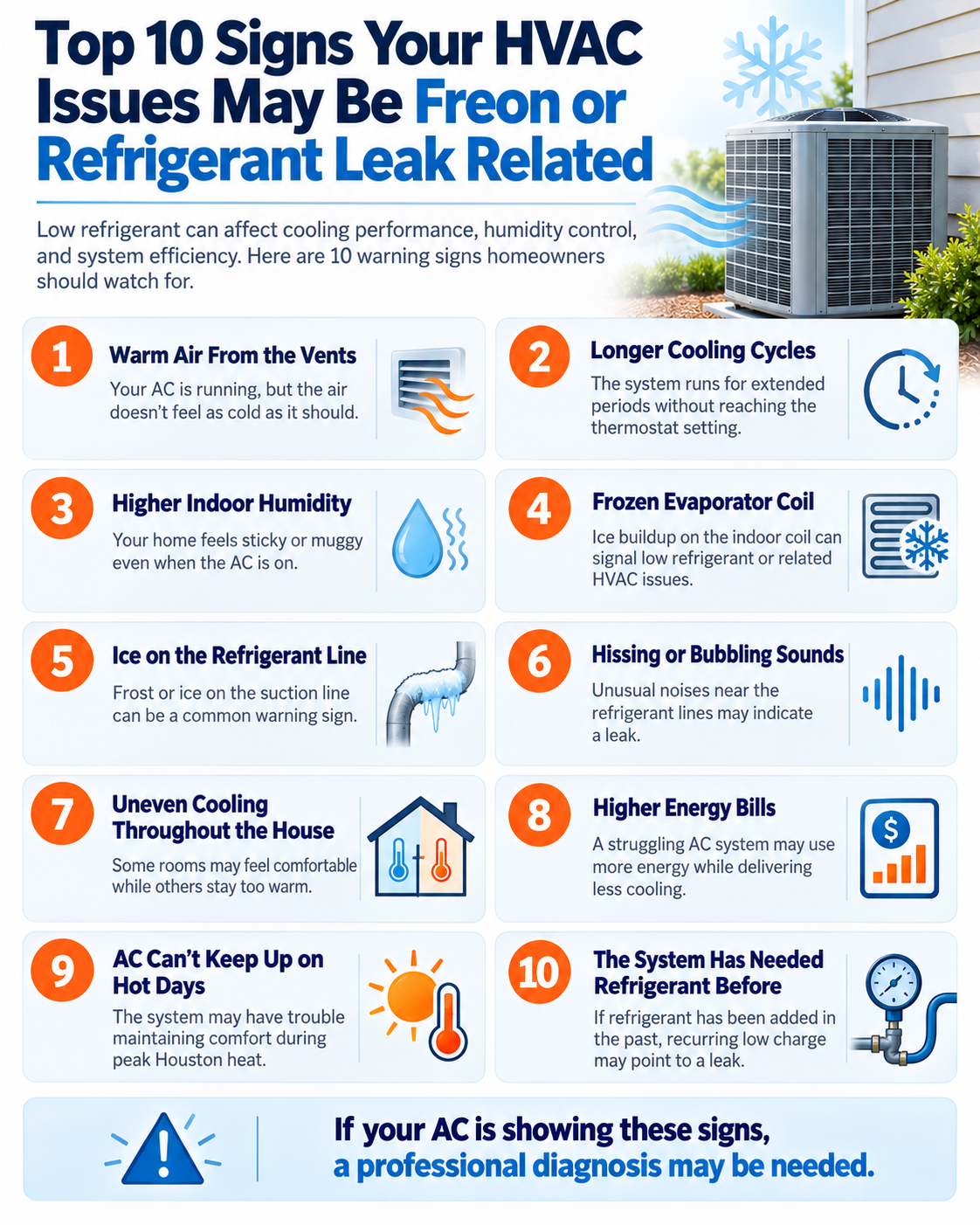
Possible warning signs include:
- Warm or insufficiently cool air
- Longer-than-normal AC run times
- A frozen evaporator coil
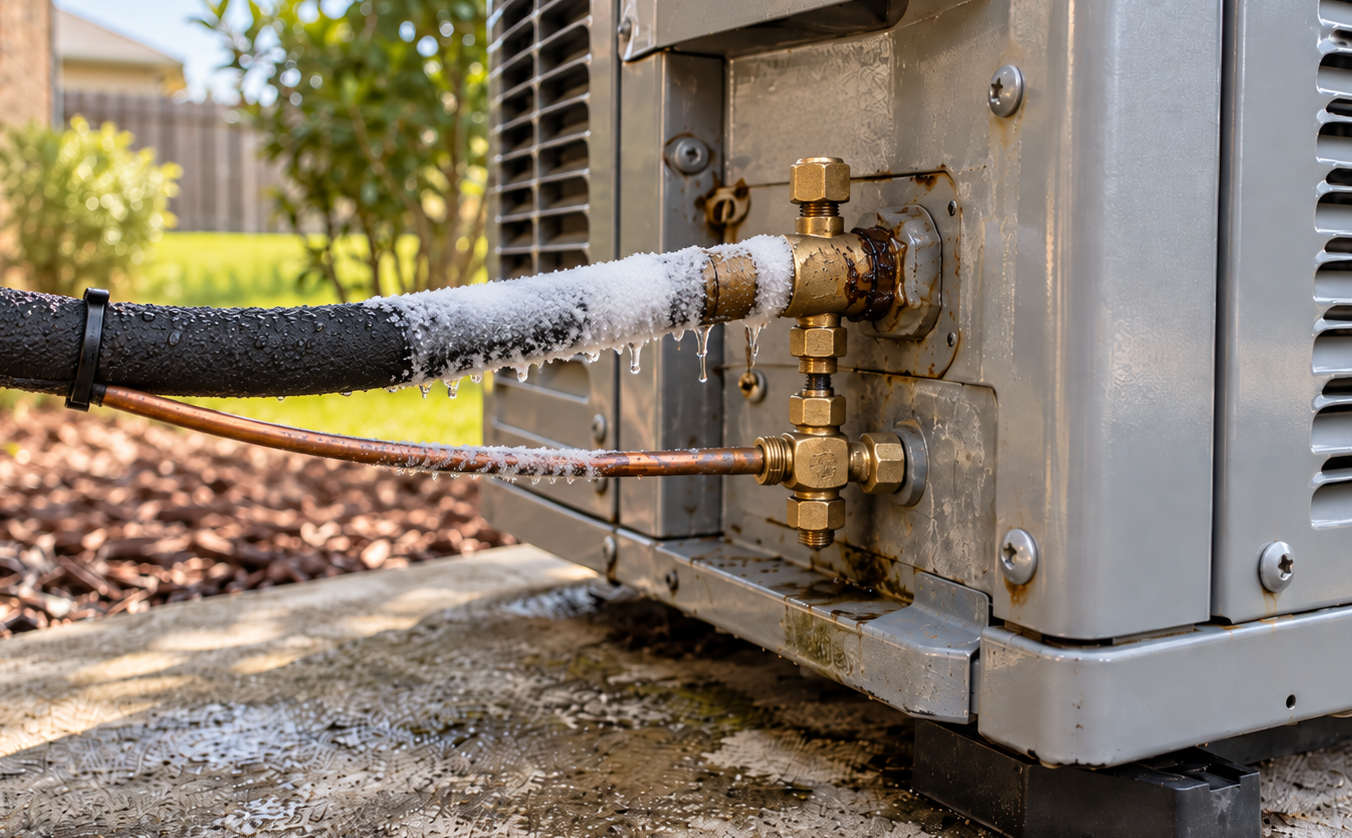
- Ice on a refrigerant line
- Hissing or bubbling sounds
- Increased indoor humidity
- Uneven cooling
- Declining system performance
- Higher cooling-related electricity use
These symptoms are not proof of a refrigerant leak.
Restricted airflow, electrical problems, thermostat issues, compressor problems, blower problems, and other HVAC conditions can produce similar symptoms.
Why Does Low Refrigerant Affect Cooling?
Refrigerant transfers heat through the air-conditioning system.
During normal operation, refrigerant absorbs heat at the indoor evaporator coil and carries that heat outside, where it is released through the condenser.
When the system does not contain the correct refrigerant charge, the heat-transfer process may no longer operate as designed.
Cooling capacity can fall, the AC may run for extended periods, and the evaporator coil may become abnormally cold and begin freezing.
In Houston, reduced cooling performance can also contribute to indoor humidity problems because the air conditioner may struggle to provide the temperature and moisture control the home requires.
Why Is There Ice on My Refrigerant Line?
Ice on a refrigerant line or evaporator coil is commonly associated with low refrigerant, but refrigerant loss is not the only possible cause.
Restricted airflow from a dirty filter, blocked return, blower problem, dirty coil, or another HVAC issue can also allow the evaporator coil to become too cold.
If substantial ice is visible, turn the cooling system off rather than continuing to operate it while frozen.
After the ice thaws, an HVAC technician can evaluate airflow, coil condition, refrigerant operation, and other system conditions to identify the cause.
Can You Check for a Refrigerant Leak Yourself?
You can look for warning signs, but homeowners generally cannot reliably confirm the refrigerant charge or accurately locate many leaks without specialized equipment.
Safe homeowner checks include:
- Confirm the thermostat is set to Cool and below the indoor temperature.
- Check whether supply air feels substantially warmer than expected.
- Inspect the air filter and replace it if it is heavily clogged.
- Make sure accessible supply vents and return grilles are open.
- Look for visible ice on accessible refrigerant piping or HVAC equipment.
- Listen for unusual hissing or bubbling near accessible equipment.
- Look for unexplained oily residue around accessible refrigerant connections.
- Note whether the AC runs much longer than normal or cannot reach the thermostat setting.
- Check the outdoor equipment nameplate to identify the refrigerant used by the system.
These checks can provide useful information for the technician, but they cannot determine how much refrigerant remains in the system or identify every possible leak.
What Should You Not Do Yourself?
Do not attempt to add refrigerant, connect gauges, open the sealed refrigeration circuit, replace refrigerant components, or intentionally release refrigerant.
Refrigerant service requires proper equipment, procedures, training, and compliance with applicable refrigerant-handling requirements.
Modern HVAC systems can also use refrigerants with different handling and safety requirements.
How Does an HVAC Technician Find a Refrigerant Leak?
A professional diagnosis goes beyond deciding that an air conditioner simply "needs Freon."
The technician first evaluates whether the system's performance actually indicates an incorrect refrigerant charge.
Depending on the equipment and operating conditions, diagnosis may include evaluating airflow, indoor and outdoor temperatures, coil condition, refrigeration-system performance, and other system measurements.
If leakage is suspected, specialized leak-detection methods can be used to locate the source.
A large and readily accessible leak may be easier to locate than a small intermittent leak hidden inside a coil or difficult piping location.
Refrigerant Type Can Affect the Repair Decision
Older R-22 Systems
Older HVAC equipment may use R-22 refrigerant.
Production and import of newly produced R-22 have been phased out in the United States, although existing systems may still be serviced using available recovered, reclaimed, or previously produced supplies.
With an older R-22 system, the refrigerant itself is only one consideration.
The equipment's age, condition, failed component, efficiency, parts availability, and likelihood of additional repairs may make it reasonable to compare a major repair with system replacement.
R-410A Systems
A large number of existing residential HVAC systems use R-410A.
These systems can continue to be serviced. The industry's transition toward lower-GWP refrigerants does not mean that an operating R-410A system automatically needs replacement.
Repair feasibility still depends on the leak location, component condition, system age, warranty status, and overall equipment condition.
Newer R-454B Systems
Newer residential cooling equipment increasingly uses refrigerants such as R-454B as the HVAC industry transitions toward lower-global-warming-potential refrigerants.
Equipment using R-454B is specifically designed for that refrigerant and its associated requirements.
Refrigerants should not be treated as interchangeable simply because they perform the same basic cooling function.
Does More Refrigerant Mean a More Expensive Repair?
The amount of refrigerant required can affect the final service cost, but it is only one part of the repair.
Consider two systems with similar low-refrigerant symptoms.
One may have an accessible connection that can be repaired.
The other may have a leaking evaporator coil that requires replacement.
The component failure, accessibility, diagnostic work, system preparation, repair procedure, testing, and final refrigerant charge can make the scope of those repairs substantially different.
That is why asking only how much refrigerant costs cannot determine the total refrigerant-leak repair cost.
Why Can an Evaporator-Coil Leak Be More Involved?
The evaporator coil is a major component located in the indoor portion of the air-conditioning system.
If the leak is within the coil itself, the repair can be considerably more involved than repairing an accessible connection or section of refrigerant line.
The technician may need to determine whether the coil can appropriately be repaired or should be replaced, whether a compatible replacement is available, whether warranty coverage applies, and what labor is required to access and restore the system.
Equipment installed in a Houston attic can add another factor because equipment location, working conditions, clearances, and disassembly requirements can affect repair complexity.
Can the Outdoor Condenser Coil Leak?
Yes.
The outdoor condenser and its refrigerant connections are part of the sealed refrigeration circuit.
Physical damage, vibration, corrosion, age-related deterioration, and other conditions can potentially result in refrigerant loss.
The correct repair depends on the exact location and condition of the failure.
Does Warranty Coverage Pay for a Refrigerant Leak?
Possibly, but warranty coverage varies.
A manufacturer warranty may cover an eligible replacement component while excluding other expenses associated with the service.
Homeowners may still be responsible for diagnostic work, labor, refrigerant, shipping, materials, or other costs depending on the applicable warranty terms.
Equipment registration, age, ownership, installation records, maintenance requirements, and the specific failed component can also affect coverage.
When Should You Compare AC Repair With Replacement?
A refrigerant leak does not automatically mean you need a new air conditioner.
Many refrigerant leaks can be repaired.
However, comparing repair with replacement can make sense when an older system has a major leaking coil, repeated refrigerant problems, declining efficiency, difficult-to-source components, other substantial repair needs, or a history of breakdowns.
The total condition of the HVAC system matters more than the refrigerant leak by itself.
When Should You Call Hage Energy?
Consider professional AC service when:
- The air conditioner is no longer cooling properly
- The evaporator coil or refrigerant line repeatedly freezes
- You hear persistent hissing or bubbling
- Cooling performance has noticeably declined
- Indoor humidity is unusually high
- The AC runs continuously without reaching the thermostat setting
- The system has required refrigerant more than once
- You have previously been told the system is "low on Freon" without being given a clear explanation for why
What Can Hage Energy Evaluate?
A refrigerant-related service call should begin with diagnosis.
Depending on the system and symptoms, Hage Energy can evaluate cooling performance, airflow, indoor and outdoor coil condition, refrigerant operation, visible indications of leakage, equipment condition, electrical operation, and other conditions that can produce similar symptoms.
If refrigerant loss is confirmed, the important questions become: Where did the refrigerant go? Can the leak be reliably repaired? What else is required to restore proper operation? And does repairing the system make sense compared with the available alternatives?
Refrigerant Leak Repair in Houston From Hage Energy
Houston's long cooling season places substantial demands on residential air-conditioning equipment.
When refrigerant loss reduces cooling capacity, a system that already operates extensively during hot weather may struggle even more to maintain comfortable indoor temperatures and humidity.
Hage Energy provides professional AC diagnostics, repair, maintenance, and system replacement services throughout Greater Houston.
If you suspect an AC refrigerant leak, call Hage Energy at 713-560-0600 or request AC service online.
Frequently Asked Questions About Freon and Refrigerant Leaks
How much does a refrigerant leak cost to repair?
There is no reliable single price without diagnosing the system. Cost depends on the refrigerant type, leak location, component involved, accessibility, amount of refrigerant lost, parts and warranty status, leak-detection requirements, and the work necessary to properly repair, test, evacuate, and recharge the system.
Does my air conditioner normally use up refrigerant?
No. A properly operating sealed air-conditioning system does not routinely consume refrigerant. Low refrigerant generally points to leakage or an incorrect charge from prior installation or service. Repeatedly needing refrigerant should be investigated rather than treated as normal maintenance.
What are the most common signs of a Freon leak?
Possible symptoms include insufficient cooling, long run times, frozen refrigerant lines or evaporator coils, hissing or bubbling sounds, uneven temperatures, increased indoor humidity, and higher cooling-related energy use. Those symptoms can also have other causes, so testing is required to confirm a refrigerant leak.
Can I check my AC refrigerant level myself?
Homeowners can check for symptoms but should not connect gauges or open the refrigeration circuit. Determining refrigerant charge requires HVAC knowledge, proper instruments, and consideration of system conditions.
Should I keep running my AC if it has a refrigerant leak?
If a refrigerant leak has been confirmed, or the system is freezing because of a suspected refrigerant problem, continued operation is not recommended. Turn the cooling system off and have the cause evaluated.
Is adding refrigerant enough to fix a leak?
No. Adding refrigerant restores the charge but does not seal the location where refrigerant escaped. If the leak remains, the newly added refrigerant can escape as well.
How do I know what refrigerant my AC uses?
Look at the equipment nameplate on the outdoor condenser or consult the owner's manual. The equipment nameplate is generally the easiest place for a homeowner to identify the refrigerant used by a central AC system.
Does an R-410A air conditioner have to be replaced because newer systems use R-454B?
No. Existing R-410A equipment can continue to be serviced. The refrigerant transition does not itself require homeowners to replace an otherwise serviceable system. Repair or replacement should be based on the equipment's actual condition, repair needs, compatibility, and the homeowner's goals.
When should I replace instead of repair an AC with a refrigerant leak?
There is no universal rule. Consider the location and severity of the leak, system condition, age, repair history, component availability, warranty coverage, refrigerant type, efficiency, and whether other major repairs are likely. A professional diagnosis allows you to compare the complete repair with an appropriate replacement option.
FAQ Context
What factors determine the cost of a refrigerant leak repair?
The cost depends on the refrigerant type, leak location and severity, equipment accessibility, system age, parts availability, and whether a component can be repaired or must be replaced.
Is adding more refrigerant a permanent fix for a leak?
No. Adding refrigerant does not repair a leak. An air conditioner's refrigeration circuit is sealed, so if the level is low, the underlying leak must be located and corrected to prevent the new refrigerant from escaping.
What are common symptoms of an AC refrigerant leak?
Symptoms can include warm air from vents, longer cooling cycles, a frozen evaporator coil, ice on refrigerant lines, hissing sounds, and higher electricity bills.