

AC Replacement Cost Guide for Houston Homeowners
A comprehensive breakdown of the equipment, efficiency ratings, and installation requirements that influence the total cost of your new air conditioner.
Planning to replace your air conditioner? Understanding what affects AC replacement cost can help you compare equipment, set realistic expectations, and choose a system that makes sense for your Houston home.
The cost of replacing a central air conditioner can vary considerably. Equipment capacity, efficiency, compressor technology, comfort features, home configuration, and installation requirements all influence the final investment.
Rather than relying on broad national averages, it is more useful to understand what causes one AC replacement to cost more or less than another. A straightforward single-stage replacement in a home with compatible existing components and easy equipment access will generally fall toward the lower end of the spectrum. Higher-efficiency equipment, variable-speed technology, difficult installation conditions, duct modifications, electrical work, accessory upgrades, or replacement of additional HVAC components can move a project toward the higher end.
What Determines the Cost of an AC Replacement?
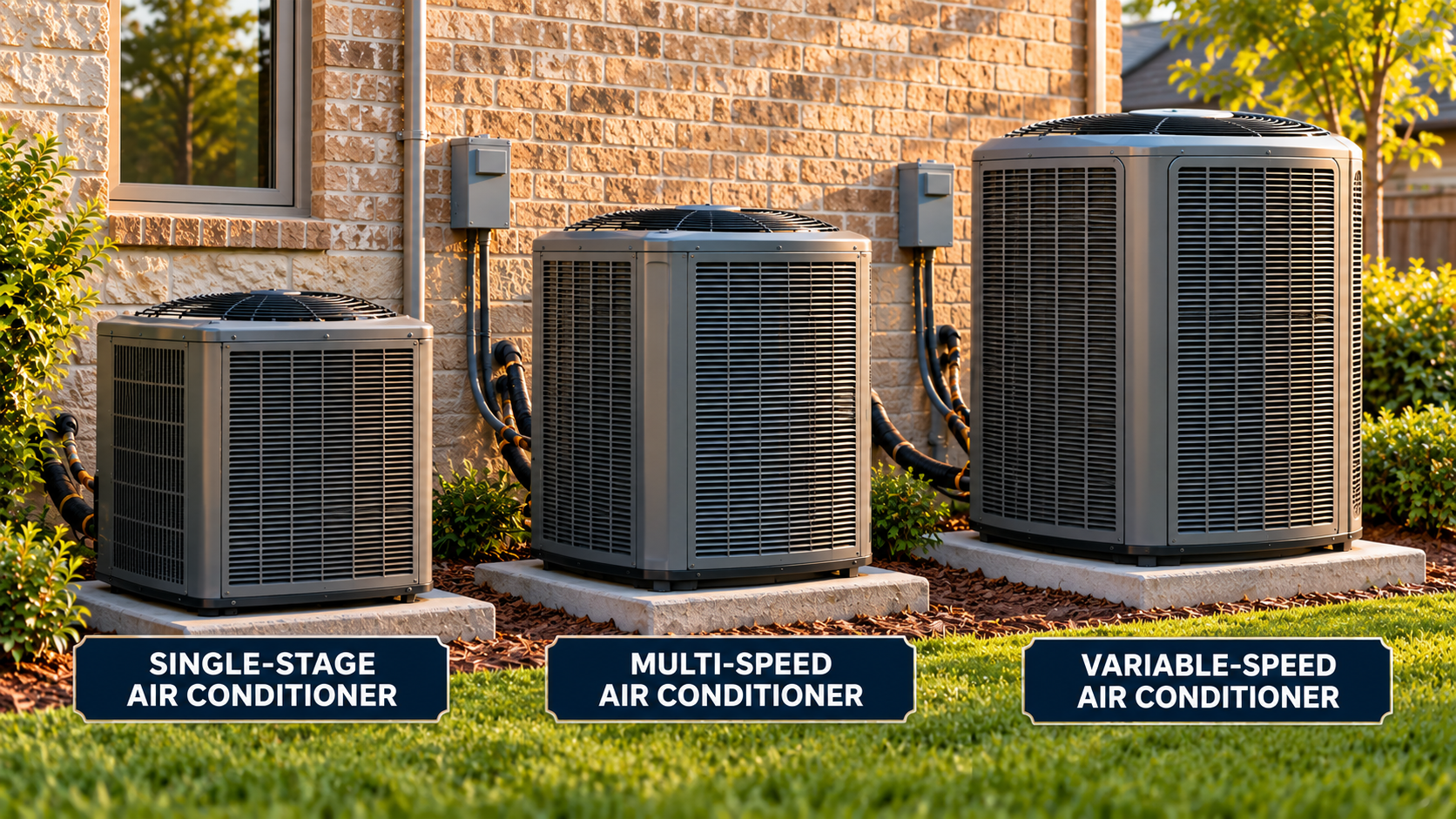
An AC replacement is more than simply purchasing an outdoor condenser.
The final project scope may include the air-conditioning equipment, indoor HVAC components, installation labor, refrigerant-system work, electrical modifications, drainage improvements, controls, ductwork, equipment removal, permits, commissioning, and other property-specific requirements.
Some homes allow for a relatively straightforward replacement using compatible components and accessible equipment locations. Others require additional work to properly integrate the new system with the home's existing HVAC infrastructure.
For that reason, AC replacement cost is best understood as a range influenced by the equipment selected and the complexity of the installation, rather than as a single standard price.
AC Replacement Cost by System Type
| AC System Type | Relative Cost Position | What Typically Influences Cost |
|---|---|---|
| Single-stage air conditioner | Generally lower-end | Simpler compressor operation and controls. Cost can increase with higher capacity, efficiency upgrades, indoor equipment replacement, ductwork, electrical work, or installation complexity. |
| Multi-speed air conditioner | Generally mid-range | Additional operating stages, improved controls, higher efficiency options, enhanced humidity management, compatible indoor equipment, and installation requirements can influence final cost. |
| Variable-speed air conditioner | Generally higher-end | Advanced compressor technology, communicating controls, higher efficiency capability, enhanced humidity management, matched indoor equipment, accessories, and system integration typically place these systems toward the higher end. |
These categories describe the general relationship between equipment types rather than a guaranteed project price. A straightforward installation of more advanced equipment may sometimes require less additional work than a complicated replacement involving simpler equipment.
The final cost depends on both what system is being installed and what is required to install it correctly in the home.
Why Does One Air Conditioner Cost More Than Another?
Two central air conditioners can perform the same basic job while differing substantially in cost, comfort capabilities, efficiency, and technology.
The biggest differences typically involve:
- Cooling capacity
- Single-stage, multi-speed, or variable-speed operation
- SEER2 efficiency rating
- Humidity-control capabilities
- Sound levels
- Controls and communicating technology
- Equipment design and features
- Indoor and outdoor equipment compatibility
- Installation requirements
The lowest-cost system is not automatically the right system for every home, just as the most advanced system is not automatically necessary for every homeowner.
The goal is to match the equipment to the home's cooling demands, comfort requirements, efficiency goals, and budget.
Single-Stage Air Conditioners
A single-stage air conditioner has the simplest cooling operation.
When the thermostat calls for cooling, the compressor runs at full capacity. When the desired temperature is reached, it shuts off.
There is no lower cooling stage.
Single-stage equipment generally represents the lower end of the equipment spectrum among the three categories covered in this guide.
When Does a Single-Stage AC Make Sense?
A single-stage system may be worth considering when keeping the initial replacement investment lower is a major priority and the home does not require more sophisticated capacity control.
Its simplicity can make it an appropriate option for many homes when the equipment is properly sized and installed.
The tradeoff is that the system cannot reduce compressor output during periods when the home requires less than full cooling capacity.
That can result in more noticeable on-and-off cycling compared with equipment that can adjust its output.
Multi-Speed Air Conditioners
Multi-speed air conditioners provide greater operating flexibility.
Rather than operating only at full cooling output, these systems can operate at different capacity levels to better match changing conditions.
This can allow the system to spend more time operating at an appropriate lower output instead of repeatedly running at full capacity and shutting off.
When Does a Multi-Speed AC Make Sense?
A multi-speed air conditioner can be a useful middle ground for homeowners who want improved comfort and operating flexibility without necessarily moving into the most advanced variable-speed category.
Potential advantages include:
- More consistent indoor temperatures
- Improved humidity management
- Fewer noticeable temperature swings
- Greater operating flexibility
- Potential efficiency improvements compared with simpler equipment
Those characteristics can be especially relevant in Greater Houston, where air conditioners operate for long periods and humidity control is an important part of indoor comfort.
Variable-Speed Air Conditioners
Variable-speed equipment offers the greatest ability to adjust cooling output.
Instead of relying on one or a small number of operating levels, variable-speed technology can continuously adjust output across a broader range to more closely match the home's cooling demand.
This additional technology generally places variable-speed air conditioners toward the higher end of equipment and replacement costs.
When Does a Variable-Speed AC Make Sense?
Variable-speed systems are typically considered by homeowners who place a higher priority on:
- Consistent indoor temperatures
- Enhanced humidity control
- Quieter operation
- Higher efficiency potential
- Longer, lower-output cooling cycles
- Advanced system controls
For a Houston homeowner, improved humidity management can be a meaningful comfort advantage.
That does not mean every Houston home requires variable-speed equipment. The additional investment should be considered alongside the home's characteristics, comfort priorities, expected ownership period, and budget.
Single-Stage vs. Multi-Speed vs. Variable-Speed AC
| Priority | System Type to Consider |
|---|---|
| Lower initial replacement investment | Single-stage |
| Straightforward operation | Single-stage |
| Balance between cost and operating flexibility | Multi-speed |
| Improved temperature consistency | Multi-speed or variable-speed |
| Enhanced humidity management | Multi-speed or variable-speed |
| Premium comfort and precise capacity control | Variable-speed |
| Quieter operation at lower output | Variable-speed |
This comparison is a starting point, not a substitute for properly sizing and evaluating the HVAC system.
AC Size Has a Major Impact on Replacement Cost
Central air conditioners are available in different cooling capacities, commonly described in tons.
One ton of cooling capacity equals 12,000 BTUs per hour.
A larger-capacity air conditioner will generally cost more than otherwise comparable equipment with a smaller cooling capacity.
That does not mean bigger is better.
An AC system should be sized according to the home's actual cooling load rather than selected using square footage alone or automatically matched to the capacity of the old system.
A proper evaluation may consider:
- Home size and layout
- Insulation levels
- Window quantity, size, orientation, and efficiency
- Sun exposure
- Exterior construction
- Air leakage
- Ductwork
- Ceiling heights
- Occupancy
- Houston climate conditions
An oversized air conditioner can cycle too quickly and may struggle to provide the temperature and humidity control expected from the system.
An undersized system can run excessively while struggling to keep up with the home's cooling load.
How SEER2 Efficiency Affects AC Replacement Cost
Modern air conditioners are rated using SEER2, or Seasonal Energy Efficiency Ratio 2.
A higher SEER2 rating indicates greater seasonal cooling efficiency under standardized testing conditions.
Higher-efficiency equipment usually carries a higher initial cost because the system may use more advanced compressor technology, motors, coils, controls, and other components.
This creates an important distinction:
The air conditioner with the lowest purchase cost is not necessarily the air conditioner with the lowest long-term operating cost.
For Houston homeowners, that can deserve particular consideration because the cooling season is long and air conditioners may operate extensively for much of the year.
Humidity Control Matters in Houston
Air conditioning does more than lower indoor temperature. It also removes moisture from the air as part of the cooling process.
Houston's hot, humid climate makes that moisture removal especially important.
System size, airflow, runtime, compressor operation, duct performance, and equipment design can all influence how effectively the HVAC system manages indoor temperature and humidity.
That is why replacement decisions should not be based on SEER2 or initial cost alone.
A system that better matches the home's actual load and comfort requirements may provide a noticeably different indoor experience even when two pieces of equipment appear similar on paper.
What Can Increase the Final Cost of an AC Replacement?
The outdoor air conditioner is only one part of a replacement project.
Depending on the home and existing HVAC system, the final proposal may also be affected by:
- Installation labor and complexity
- Removal and disposal of existing equipment
- Indoor coil or air-handler replacement
- Refrigerant line-set modifications or replacement
- Electrical upgrades
- Disconnect or breaker changes
- Condensate drainage modifications
- Equipment pads or mounting changes
- Attic access and working conditions
- Duct repairs or modifications
- Thermostat and control upgrades
- Zoning systems
- Indoor air quality equipment
- Humidity-control accessories
- Permitting or code-related requirements
- Equipment compatibility
- Other property-specific installation needs
Not every home requires every item on this list.
A home with accessible equipment, properly sized ductwork, compatible electrical service, and relatively straightforward equipment replacement may remain toward the lower end of the overall project spectrum.
A home requiring indoor equipment changes, extensive duct modifications, electrical upgrades, difficult attic access, refrigerant-system work, advanced controls, or additional accessories can move toward the higher end.
That is why an in-home evaluation provides a much more useful basis for estimating replacement cost than a generalized average.
Why Attic Installations Can Affect AC Replacement Cost
Many Greater Houston homes have HVAC equipment located in the attic.
Attic installations can vary substantially.
Some provide open access and adequate workspace. Others have narrow openings, limited decking, low roof clearances, difficult equipment paths, or systems positioned far from the attic entrance.
If indoor equipment also needs to be replaced or modified, accessibility can influence the amount of labor and planning required.
The condition of the drain system, supply and return ductwork, equipment platform, and surrounding installation can also affect the scope.
Does Replacing the AC Mean Replacing the Whole HVAC System?
Not always, but the outdoor condenser does not operate independently.
A central air conditioner works with indoor HVAC components as a matched system.
Depending on equipment age, refrigerant type, efficiency requirements, component compatibility, and system condition, replacing the outdoor unit may require replacement or modification of other components.
Matching matters because system performance, capacity, efficiency, and controls depend on components working together as designed.
An in-home evaluation can determine which components can appropriately remain and what should be replaced.
What About Older Refrigerant Systems?
Refrigerant compatibility can influence replacement decisions.
Older systems may use R-22. A large number of existing systems use R-410A. Newer residential equipment increasingly uses lower-global-warming-potential refrigerants such as R-454B.
These refrigerants and their associated equipment are not simply interchangeable.
If an older air conditioner is being replaced, the refrigerant system, indoor equipment, line set, and compatibility requirements should all be considered as part of the project.
Should You Repair Your Current AC or Replace It?
A repair does not automatically mean replacement is necessary.
Likewise, repeatedly repairing an aging system is not always the most economical long-term decision.
Factors worth considering include:
- Age of the existing system
- Scope of the current repair
- Repair history
- Condition of major components
- Refrigerant type
- Cooling performance
- Humidity control
- Energy efficiency
- Availability of replacement parts
- Likelihood of additional repairs
- How long you expect to remain in the home
A relatively minor repair on an otherwise healthy system may make sense.
A major repair on older equipment with additional problems may justify comparing the repair with replacement options.
Don't Compare AC Replacement Quotes on Price Alone
Two HVAC replacement proposals with different costs may not be proposing the same work.
When comparing quotes, look beyond the bottom-line number.
Ask what equipment is included, what components are being replaced, what efficiency level is proposed, whether the equipment is properly matched, whether ductwork or electrical work is required, what accessories are included, and what installation and warranty provisions apply.
A lower-cost quote can represent good value when the scope is appropriate.
It can also be lower because important work, components, or specifications are different.
Understanding the scope makes the comparison more meaningful.
Why Installation Quality Matters
Equipment specifications are only part of HVAC performance.
Even high-end equipment can underperform when the system is incorrectly sized, improperly matched, poorly installed, or not commissioned correctly.
A quality replacement should account for the home, equipment, airflow, drainage, electrical requirements, refrigerant system, controls, and overall installation rather than treating the project as a simple box-for-box swap.
Choosing an AC System for a Houston Home
Houston's climate places substantial demands on residential air conditioning.
A replacement decision should account for more than simply whether a system can produce cold air.
Important considerations may include:
- Cooling capacity during peak summer conditions
- Humidity control
- Energy efficiency
- Runtime characteristics
- Indoor temperature consistency
- Equipment noise
- Duct performance
- System controls
- Long-term serviceability
Hage Energy provides residential air-conditioning installation and replacement services throughout Greater Houston and offers Trane equipment along with service for major HVAC brands.
The appropriate replacement begins with evaluating what the home actually needs.
Comparing Trane AC Options
Hage Energy offers Trane air-conditioning equipment with options spanning different efficiency levels, compressor technologies, operating stages, comfort features, and system configurations.
A homeowner may prefer the simplicity of a single-stage system, the added flexibility of multi-speed equipment, or the temperature and humidity control available from variable-speed technology.
The right choice depends on what the homeowner values and what works correctly with the property.
Financing an AC Replacement
Replacing an HVAC system can be a significant household expense, especially when replacement becomes necessary unexpectedly.
Hage Energy offers financing options for qualified customers for eligible HVAC replacements, high-efficiency equipment upgrades, major repairs, duct modifications, and other approved improvements.
Financing is subject to lender approval and applicable terms.
Financing does not determine which air conditioner is right for your home, but it can provide another way to manage the investment once an appropriate system has been selected.
Get an AC Replacement Evaluation From Hage Energy
General AC replacement information can help you understand why one project may fall toward the lower or higher end of the cost spectrum.
It cannot account for your home's actual cooling load, HVAC configuration, ductwork, electrical system, equipment access, comfort priorities, or installation requirements.
Hage Energy can evaluate your existing system, discuss appropriate replacement options, and provide pricing based on the actual equipment and work required for your Houston-area home.
Call Hage Energy at 713-560-0600 or request an AC replacement evaluation online.
Frequently Asked Questions About AC Replacement Cost
How much does it cost to replace a central air conditioner?
There is no single replacement price that applies to every home. Cost can vary substantially based on system capacity, efficiency, compressor technology, indoor equipment compatibility, home configuration, accessibility, ductwork, electrical requirements, controls, accessories, and the amount of installation work required.
What typically puts an AC replacement toward the lower end of the cost range?
A relatively straightforward replacement using appropriately sized conventional equipment, compatible existing components, accessible installation locations, adequate ductwork, and minimal electrical or refrigerant-system modification will generally remain toward the lower end compared with a more complex project.
What can push an AC replacement toward the higher end?
Higher-capacity or higher-efficiency equipment, variable-speed technology, matched indoor equipment replacement, advanced controls, difficult attic access, duct modifications, electrical upgrades, refrigerant-line work, zoning, indoor air quality equipment, humidity-control accessories, and other installation requirements can all increase the scope of a replacement.
Why does variable-speed AC generally cost more?
Variable-speed systems use more advanced compressor and control technology that allows cooling output to adjust across a wider operating range. That technology can provide enhanced temperature consistency, humidity management, efficiency, and quieter operation but generally increases equipment and system complexity.
Does a bigger AC unit generally cost more?
Higher-capacity equipment generally costs more than otherwise comparable lower-capacity equipment. However, the correct size should be determined by the home's cooling load. Installing a larger system than the home needs can negatively affect comfort, efficiency, and humidity control.
Does higher SEER2 increase AC replacement cost?
Higher-efficiency systems generally require a greater initial investment because of the equipment and technology used to reach higher efficiency ratings. The potential benefit should be considered alongside cooling usage, energy costs, comfort goals, and how long you expect to own the system.
Does the condition of my ductwork affect replacement cost?
It can. If existing ducts are damaged, undersized, leaking, poorly configured, or otherwise unable to support the new system properly, duct repair or modification may be recommended as part of the replacement project.
Can Hage Energy give me an exact replacement price without seeing my home?
A reliable replacement proposal should account for the home, existing system, equipment sizing, compatibility, access, ductwork, electrical requirements, and installation conditions. An in-home evaluation provides a more accurate basis for selecting equipment and determining project cost.
Should I repair or replace my current AC?
That depends on the age and condition of the equipment, the repair needed, repair history, refrigerant type, efficiency, comfort performance, parts availability, and expected future reliability. Hage Energy can evaluate the existing system and help you compare the available options.
FAQ Context
What determines the cost of an AC replacement in Houston?
The cost is determined by equipment capacity, efficiency, compressor technology, and home-specific factors like ductwork, electrical needs, and installation complexity. The final scope includes equipment, labor, refrigerant work, and permits.
How does the type of AC system affect its replacement cost?
Single-stage air conditioners are generally the most affordable. Multi-speed systems are mid-range, offering better efficiency and humidity control. Variable-speed systems are typically the highest cost due to their advanced technology and superior performance.
Why does one air conditioner cost more than another?
Cost differences arise from variations in cooling capacity, compressor type (single-stage vs. variable-speed), SEER2 efficiency, humidity control features, sound levels, and the complexity of controls and installation requirements.